
Over the past three months, the central Mediterranean has once again exposed a stark conflict: on one side, people on the move fighting for their freedom of movement and civilian actors attempting to prevent deaths at sea; on the other, a growing architecture of legal pressure, administrative obstruction, and border externalisation that increasingly targets solidarity and the right to mobility.

Escalating Detentions of Civil Rescue Vessels Under the Piantedosi Decree
After rescuing 92 people, including 31 unaccompanied minors on the 3rd of November, the NGO vessel Mediterranea was accused by Italian authorities of violating the Piantedosi Decree for not immediately heading to the distant port of Livorno instead of disembarking in Porto Empedocle. The vessel invoked a formal declaration of a state of necessity, many survivors being traumatized and unfit for a four-day voyage in rough seas. While the captain argued that international maritime law allowed disembarkation at the nearest safe port, medical authorities and the Palermo Juvenile Court had deemed the rescued individuals unfit for several more days at sea and requested the minors’ disembarkation. Italian authorities, however, stated that this action violated the Piantedosi Decree, highlighting a conflict between humanitarian obligations and national regulations, and on November 15, imposed 60 days of detention and a €10,000 fine on the vessel. Mediterranea was therefore the first ship of the Justice Fleet alliance getting detained.
Another rescue vessel, Humanity 1, was also detained in the Italian port of Ortona after disembarking 85 people on the 2nd of December, making it the second ship detained as part of the Justice Fleet. The detention order stated that the ship did not communicate with the Libyan Rescue Coordination Centre. SOS Humanity stated the crew acted in accordance with international maritime law and deliberately suspended communication with Libyan authorities because they considered the so‑called Libyan Coast Guard illegitimate, a view supported by an Italian court in Catanzaro.
In December 3rd, 2025, the Court of Agrigento suspended the administrative detention of the NGO vessel TROTAMAR III, ruling that failure to notify Libyan authorities of rescue operations is not legally grounds for sanctions, fines, or detention. The court emphasized that penalties can only be applied for violations explicitly listed in law, and the omission to communicate with the Libyan Rescue Coordination Centre does not meet these criteria, especially given Libya’s lack of credibility and unsafe conditions for rescued persons. This decision reinforces the legal protection of civil rescue vessels in the Central Mediterranean and highlights the illegality of applying the Piantedosi decree against humanitarian NGOs.
After rescuing 18 people in distress in international waters on 24 January 2026, the German rescue vessel Sea-Watch 5 was detained by Italian authorities for 15 days and fined €7,500. Authorities justified the measure by alleging that the organization had refused to inform the so-called Libyan Coast Guard about the rescue operation. Sea-Watch counters that these actors had previously attempted to intimidate the crew and ordered the ship to leave the area (an instruction the NGO argues has no basis under international law) and announced it would challenge the detention in court.
On February 13th, Italian authorities detained the rescue ship Humanity 1 in the port of Trapani, Sicily, ordering it to remain there for 60 days and imposing a €10,000 fine after the vessel rescued 33 people in distress at sea. The following day, on 14 February 2026, SOS Humanity publicly condemned the measure, arguing that its crew had informed all relevant rescue coordination centres in line with international maritime law. Interior Minister Matteo Piantedosi announced the detention on X, calling the crew’s conduct “irresponsible” and claiming it put lives at risk, accusations the organization strongly rejects. In response, SOS Humanity issued a press release denouncing the decision as an obstruction to life-saving operations at a time when hundreds of people are reported missing in the Central Mediterranean.
Accountability in the Central Mediterranean
While ships are detained at ports, another struggle unfolds inside courtrooms. The criminal trial over the Cutro shipwreck has begun, with proceedings expected to examine responsibility for the deaths that occurred. The Cutro shipwreck refers to the tragic sinking of the wooden vessel Summer Love off Steccato di Cutro, Calabria on 26 February 2023, in which at least 94 migrants, including many children, died amid alleged delays in rescue response by Italian authorities. In response, six Italian officials from the Coast Guard and Guardia di Finanza were put on trial in early 2026 on charges including negligent shipwreck and multiple manslaughter, with 86 civil parties including survivors, families, and NGOs joining the case. Several SAR NGOs have acted as civil parties to demand accountability and transparency for the failures in search and rescue efforts that contributed to one of the deadliest migrant tragedies in the Central Mediterranean.

Shipwreck remains by a beach in Cutro. Picture: Alarm Phone
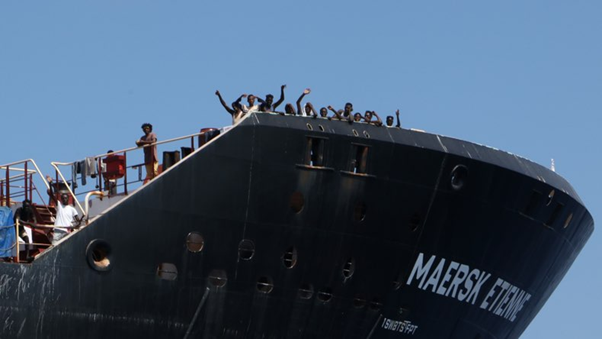
At the same time, legal action connected to the Mare Jonio and Maersk Etienne cases continues, with a hearing in Ragusa on October 21, 2025. In this case, six activists are accused of “aggravated facilitation of illegal immigration” for their involvement in the 2020 rescue of 27 shipwreck survivors abandoned on the Danish tanker Maersk Etienne for 38 days before being transferred to the NGO vessel Mare Jonio. Prosecutors allege the rescue constituted illegal immigration and “profit motive” based on a later donation, but Mediterranea argues the action was a lawful humanitarian response when Malta and Denmark failed to assign a safe port. Mediterranea has stated its intention to turn accusations against solidarity into a broader reckoning over who allows people to die at sea.
On December 18, 2025, Maurizio Belpietro, former editor of Panorama, was convicted of defamation for calling humanitarian NGO workers “pirates” on the magazine’s front page in November 2022. The Court of Milan ruled that he must pay €10,000 in provisional damages to Open Arms, EMERGENCY, Sea-Watch, SOS Mediterranee, Louise Michel, and Mediterranea, and €7,000 to AOI Rete Nazionale. The NGOs, which had joined the proceedings as civil parties, described the headline as false and offensive, emphasizing their lawful and life-saving operations in the Central Mediterranean. They welcomed the ruling as a vindication, stating it restores the truth, defends solidarity, and reinforces that humanitarian work cannot be criminalized or defamed.
A new MRCC in Benghazi, place-of-safety arrangements and list of safe countries: strengthening EU border externalisation
Beyond the courtroom, policy decisions continue to project migration control outward. Reports indicate that millions more euros continue to be directed toward cooperation with actors in Libya. The Italian government, with support from the European Commission, plans to establish a new maritime rescue coordination centre in Benghazi using EU funds, effectively extending existing structures and resources to eastern Libya. SAR NGOs criticise this initiative as supporting cooperation with armed groups accused of war crimes and using public funds to strengthen mechanisms that intercept and return people to detention and abuse, rather than saving lives at sea.
This approach fits within a broader strategy to strengthen migration partnerships, through which European states support migration management beyond their own territory via funding, training, and coordination frameworks. In a document leaked by Statewatch, the EU Presidency proposes “place-of-safety arrangements” as a way to reduce “irregular migration” and deaths at sea. Under this model, people rescued or intercepted at sea would be disembarked in non-EU third countries, where they would be temporarily received, screened, and potentially have their asylum claims processed or be returned, based on partnerships with those countries. It remains unclear if and when this proposal (which echoes the disembarkation platforms proposed by the European Commission in 2018) will be implemented.
On February 10th, the European Parliament also approved new asylum rules that establish an EU‑wide list of “safe third countries” and “safe countries of origin,” allowing member states to fast‑track asylum rejections and deportations based on those designations. Critics warn that this could undermine the individual right to seek asylum and expose vulnerable people to unsafe conditions in countries judged “safe” despite ongoing rights concerns. The official list of safe countries of origin includes Bangladesh, Colombia, Egypt, India, Kosovo, Morocco, and Tunisia. These same countries are expected to feature in discussions around “safe third countries” in parts of the proposed rules, although an EU‑wide safe third country list has not yet been finalised, and individual member states will still determine their own lists or apply the concept case‑by‑case. Ahead of the European Parliament vote on February 10th, a coalition of search and rescue and human rights organisations urged MEPs to reject the EU-wide list of “safe countries of origin,” arguing that Tunisia for example does not meet the criteria.
People on the move Under Attack in Tunisia and Libya
In Tunisia, conditions for people on the move continue to deteriorate sharply. Reports from January and February 2026 document forced “voluntary” returns (VHR) coordinated by IOM, often under coercion, alongside repeated police raids on informal camps in cities like Sfax. Civil society organizations have documented tents and shelters being burned, leaving people on the move exposed to harsh winter conditions with no safe alternatives. These operations, framed as “migration management”, have created an atmosphere of fear and displacement, forcing people to live in constant precarity. In addition, many intercepted at sea continue to be forcibly deported to border areas, often in dangerous and isolated locations with no access to services and sometimes being sold to militias, a practice highlighted by various reports and a recent testimony collected by Alarm phone.
In Libya, the fragile social and political environment is increasingly tense, raising additional risks for migrants and displaced populations. The murder of the son of Muammar Gaddafi has sparked fears of social unrest, retaliatory violence, and localized conflicts, and potentially destabilizing regions where people on the move are already in a very precarious situation. Combined with ongoing EU-backed cooperation with armed actors and militia-controlled detention centers, these developments amplify the dangers faced by people on the move, including arbitrary detention, abuse, and exposure to armed clashes.
According to Alarm Phone’s analysis covering July-December 2025, people on the move continued to cross the Central Mediterranean despite facing violent attacks and pushbacks. Most departures originated from Libya, with rescue operations saving hundreds of boats under challenging conditions. The report also highlights the tragic human cost, estimating over 1,300 deaths, underscoring the persistent dangers of border violence. In January 2026, at least 380 migrants were officially listed as missing after eight boats departed from Sfax, Tunisia, during extreme weather caused by Cyclone Harry. An article published by Refugees in Libya, based on community testimonies suggest the true number could be far higher and possibly exceed 1,000.
Italy’s New “Sicurezza” Decree: A Turning Point for Civil Liberties and Sea Rescue
On February 5, the new Italian “Sicurezza” decree-law, whose latest amendments follow the repression of last Saturday’s demonstration in Turin, was approved by the Council of Ministers. Its provisions will adversely affect civil society as a whole and any form of protest action, in line with the previous decree.

A first set of measures allows for the preventive banning of certain vessels from entering Italian territorial waters. The duration of the ban, adopted by decision of the Council of Ministers and on the proposal of the Minister of the Interior, Piantedosi, would initially be 30 days but could extend up to six months. It could be justified by a terrorism threat or a health emergency, but also by an “exceptional migratory pressure,” although this remains undefined.
In reality, this preventive and selective closure of territorial waters, readily bypassing international maritime law and the right to asylum in the name of national security, explicitly targets SAR NGOs. Meloni presents this flagship measure of her political program as a “selective naval blockade,” following the security decrees of Salvini in 2018 and 2019, which initiated the “season of closed ports,” that is, the refusal to assign Italian ports to rescue vessels requesting them. Indeed, these measures target sea rescue operations for people on the move, who are accused of being a “pull factor” for those disembarked on Italian territory.
From now on, it will no longer be the administrative authority that can prohibit entry, but the Council of Ministers through a political measure, and therefore one that is difficult to subject to judicial review, whereas courts often annulled administrative bans. Yet these vessels have no other European countries to turn to when seeking the assignment of a safe port after rescuing people in distress in the Central Mediterranean. What will become of the rescue at sea of the thousands of people who cross this deadly migration route?
A second measure provides for a limitation on judicial oversight in the validation of expulsion and detention decisions concerning foreign nationals, to avoid “interpretative distortions.” This second measure effectively makes it more difficult for judges to rule on and potentially overturn measures adopted by the Ministry of the Interior, and follows the courageous decisions of judges in recent months that were seen as an obstacle to the government’s ambitions. This provision also facilitates “faster and more effective expulsions” of individuals considered dangerous by drastically reducing appeal deadlines and introducing a similar measure regarding their transfer to centers in Albania.
In recent months, several Italian judges have opposed the transfer of foreign nationals to Albanian centers on the grounds that there is no legal framework in place pending the adoption of the Pact. The government argued the opposite, claiming that European law already authorized such transfers to extraterritorial centers. Due to these legally conflicting interpretations of the texts in force, the Albanian centers have not been used for two years.
Moreover, this decree-law contains other particularly concerning repressive measures. Notably, it introduces the “preventive detention” of protesters who are arrested, as long as they are suspected “of posing a danger to the peaceful conduct of the demonstration and to public safety.” Finally, Prime Minister Meloni has proposed suspending administrative investigations opened after the use of a weapon, resulting in serious injury or even the death of a citizen, by a police officer, thereby endorsing a presumption of self-defense.
Despite relentless attacks on humanitarian rescue, civil society has fought back, turning criminalization attempts into victories for solidarity and international law. Yet with a harsh new decree in Italy, increased border externalisation, and increased level of violence at sea and on land, the fight for solidarity with people on the move will have to continue stronger than ever!
Jeanne Tesson (Pilotes volontaires) and Sophie-Anne Bisiaux (Echoes team)